A used Audi RS6 combines a large family estate with a very powerful engine. It is also a heavy car, expensive to maintain, and the listing rarely tells you what matters most. Before you travel to see one, you need to know which generation you are looking at, then what to ask the seller and what to check on site.
Four generations, three engines
The RS6 has existed since 2002. Four generations have followed one another so far, known by their platform codes: C5, C6, C7 and C8. Three engines follow one another: a 4.2 twin-turbo V8 in the C5, a 5.0 twin-turbo V10 in the C6, then a 4.0 twin-turbo V8 in the C7 and C8.
Two things never change: quattro all-wheel drive and a torque-converter automatic gearbox. The second already sets it apart from the RS4, whose gearboxes change from one generation to the next, as explained in our guide to the used Audi RS4.
This article does two things: it helps you place a listing in its generation, then tells you which documents to ask for and what to inspect.
C5 (2002-2004): the 4.2 twin-turbo V8
The first RS6 produces 450 PS (metric horsepower). It was sold as a saloon and as an Avant estate, with a five-speed tiptronic gearbox. It is the car that introduced the DRC chassis, short for Dynamic Ride Control.
Today, this is a car more than twenty years old. Age matters more than mileage: hoses, seals, wiring looms and control units age by the calendar, whether the car is driven or not.
The points to have documented:
- the last major service, with its date and mileage
- gearbox and drivetrain oil changes
- any work on the turbos, the cooling system and the DRC
Work without an invoice should be treated as work not done, and therefore priced in.
C6 (2008-2010): the 5.0 twin-turbo V10
The C6 moves up to 580 PS, as a saloon and as an Avant, with a six-speed tiptronic gearbox. Its production run was short and few examples exist.
For the owner, the main thing the V10 changes is mechanical access. The engine fills the bay, and a job that would be routine on another car takes more labour hours here. Workshops that really know this engine are rare.
The question to ask the seller is simple: who maintained the car, and with which invoices. A complete file, kept by a workshop used to the model, tells you more than low mileage with no paperwork.
C7 (2013-2018): 4.0 TFSI V8 and Performance version
The C7 returns to a V8 with the 560 PS 4.0 TFSI twin-turbo and an eight-speed tiptronic gearbox. It exists only as an Avant. The Performance version raises output to 605 PS.
To tell the two versions apart, do not rely on the listing text alone. The vehicle registration document (permis de circulation) states the power in kW: 412 kW for the 560 PS car, 445 kW for the Performance. A remapped 560 PS car is not a Performance, even if the registered power has been changed. If in doubt, the factory equipment list pulled from the chassis number settles it.
Reading a high-mileage C7
Many C7s have covered a lot of kilometres, which is perfectly normal for a long-distance car. The figure tells you less than the invoices do:
- engine oil changes at short intervals, or stretched to the maximum of the service schedule
- oil supply to the turbos: ask whether any work has been done, and for the invoice
- gearbox and differential oil changes
- suspension: parts already replaced, and when
C8 (from 2019): 48 V mild hybrid and rear-wheel steering
The C8 produces 600 PS, then 630 PS in Performance form. Like the C7, it exists only as an Avant. Its 48 V mild hybrid system relies on a starter-generator that recovers energy under deceleration. It does not allow electric-only driving.
The body is noticeably wider than that of an A6 Avant, with 21 or 22 inch wheels. Measure your parking space before you sign. Rear-wheel steering depends on the specification, the country and the model year.
On a recent example, a manufacturer warranty may still be running. Have this confirmed in writing by the brand's network, using the chassis number. If the service record mixes several workshops, read our article on servicing outside the dealer network and the manufacturer warranty.
Air suspension or DRC: knowing what the car has
The C5 and C6 use DRC. From the C7 onwards, Audi presents adaptive air suspension as the standard setup, and the RS sport suspension plus with DRC as the alternative. What a given car actually has depends on its specification.
To find out, ask for the factory equipment list, which the brand's network can pull from the chassis number. Inside the car, air suspension offers a ride height setting.
What to look at:
- the stance at rest, with the car cold, on level ground: equal height at all four corners
- a car that has sagged on one side after standing overnight
- a compressor that runs for a long time or often
- oily traces on the dampers or lines of a DRC chassis
- knocking noises on rough roads
The RS4 guide describes how a leaking DRC feels on a test drive.
Which RS6 for which use
- Daily family car: C7 or C8, for the driver assistance systems and the cabin space.
- Long journeys: C7 or C8 with air suspension, more supple on the motorway.
- Towing: check that the tow bar is original equipment and read the towing capacity entered on the vehicle registration document.
- Weekend enjoyment: the C6 for its V10, provided you accept long workshop jobs.
- Modern classic: the C5, with a refurbishment budget to plan from the day you buy.
In every case, the weight, around two tonnes, and the power drive the cost of consumables. No generation escapes this.
Equipment to spot in the listing
- Carbon-ceramic brakes: look through the wheels. The discs have a matt grey appearance and the calipers carry specific markings.
- RS sport exhaust: have it confirmed by the factory list, the look of the tailpipes is not enough.
- Package raising the top speed: invisible on the car. Only the factory list proves it.
- Rear-wheel steering (C8): when manoeuvring at very low speed, the rear wheels turn, which can be seen from outside.
- Tow bar: have it deployed and folded away in front of you.
- Panoramic roof: open it, close it, operate the blind, look for traces of damp.
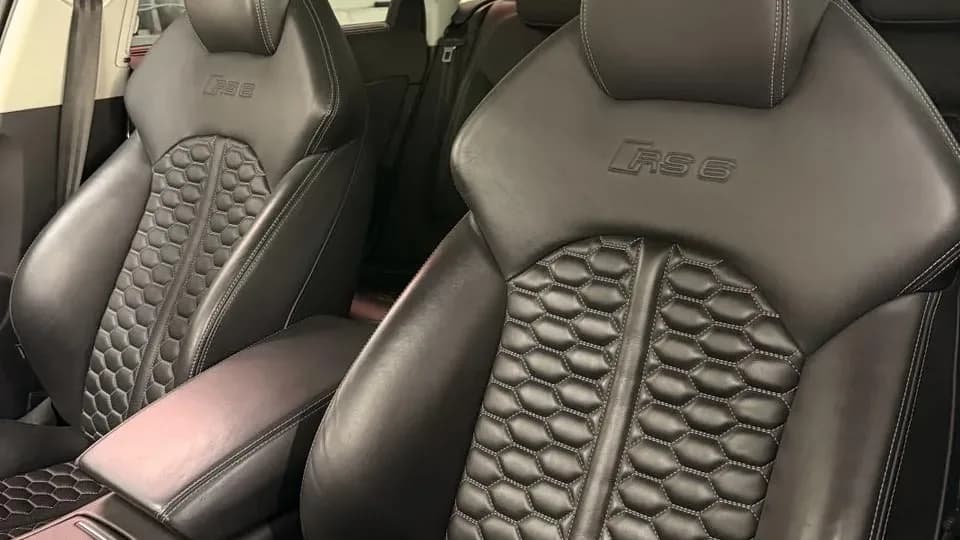
- Seats: test every adjustment, the heating and the ventilation.
- Second set of wheels: ask to see it. Note the size and the manufacturing date of the tyres.
On the test drive: what to listen for and what to look at
Ask that the car has not been run before your visit. Put your hand on the bonnet: it should be cold.
With the ignition on, the warning lights come on; once the engine is running, none should stay lit. On start-up, listen for metallic noises, check that the idle is steady, and watch the exhaust. On the move, the gears should change without jolts, cold and then warm, in automatic and in manual mode.
If the car offers several suspension modes, try each one: you should feel the difference. Brake firmly in a straight line with a light grip on the steering wheel. The car should neither pull nor vibrate.
Tyres, brakes, suspension: the wear items to price
A C8 runs on 275/35 R21 or 285/30 R22 tyres, to be checked on the sidewall. As a rule, a size that differs from the original has to be entered on the vehicle registration document or covered by an approval document. These sizes are expensive, and the weight wears them quickly. Run your hand over the inner shoulder of the front tyres, which is often more worn than the rest.
On steel discs, look at the lip on the edge of the disc. On ceramic discs, wear is measured in a workshop, not by eye.
The method has three steps: record the condition with photos, ask a workshop for a quote before negotiating, then factor that amount into the price.
Tuned or remapped RS6: the questions to ask
The RS6 is often modified: engine map, exhaust, wheels, tuner kits. Ask for a written list of the modifications, the invoices, and the original parts if they still exist. As a rule, a modified part has to be entered on the vehicle registration document or covered by an approval document, and the insurer has to be informed. The details are in our article on what a remap changes at resale.
Paperwork: service book, digital history, inspection, warranty
Ask for the service book or a printout of the digital history kept by the network, the invoices, and the date of the last periodic vehicle inspection (expertise), which appears on the vehicle registration document. Check that the modifications are entered there, or covered by an approval document.
A warranty is never implied: it exists only if it is written, in the contract or expressly stated in the listing. It depends on who signs as the seller and on what the contract says: any seller can limit or exclude it by contract, except for a defect fraudulently concealed. Read the clause before you sign. See who the seller is when the car is on consignment, and the guide to buying a used car in Switzerland for the rest.
A commercial warranty such as Quality1 is a paid option. It exists only if it has been taken out and written into the contract.
Financing, insuring, protecting
Before you choose, read cash, loan or leasing: comparing on total cost. You can then simulate a monthly leasing payment.
With leasing, the contract generally requires fully comprehensive insurance (casco complète). Ask for an insurance quote before you sign: the premium for an RS6 weighs on the annual budget.
The front end, wide and low, takes a lot of stone chips. You can protect the front end with PPF film.
See the vehicles available
The stock changes often, and an RS6 is not always in it. You can see the vehicles available, or browse the cars already sold by the garage to get an idea of the models that pass through. Do you have a specific listing in mind? You can ask your questions before you travel.