
"What is my car worth?" Everything starts with that question, and most answers found online are averages calculated on markets that are not ours. The Swiss market has its own levels, its own criteria, and a few particularities that foreign calculators ignore entirely. Here is how a professional actually values a vehicle, and what genuinely moves the final figure.
A valuation is not a price, it is a range
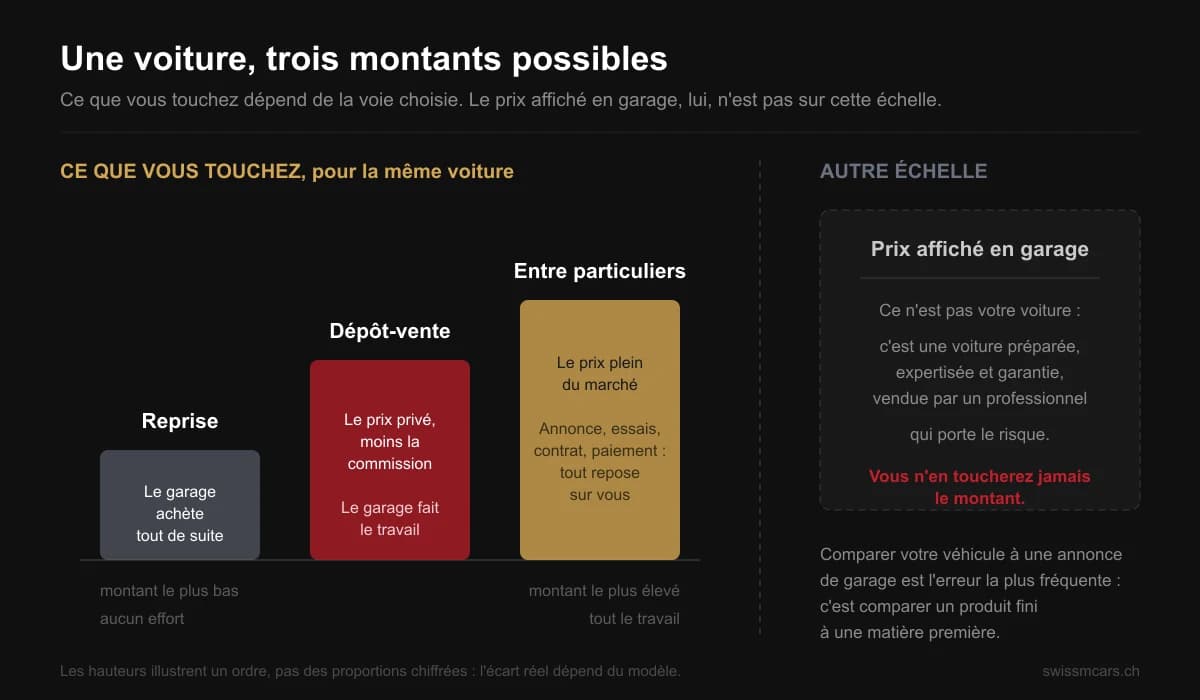
For one and the same car, what you receive depends on the route you choose. Three routes, three amounts, and the gap between them is considerable.
- Trade-in: the garage buys for its own account and pays you immediately. The lowest amount, because it absorbs its margin, the preparation, the warranty it will have to offer and the risk of not reselling.
- Consignment: the garage sells on your behalf. You receive the private market price, less its commission, without doing the work. The amount sits between the other two.
- Private sale: the full market price. The highest amount, but the ad, the test drives, the contract and collecting the money rest entirely on you.
The amount rises as the work falls back to you. That is the only constant rule, and on its own it explains most of the differences.
There remains a fourth figure, the one everybody looks at and nobody should use as a reference: the forecourt price. That is not your car, it is a prepared, inspected and warranted vehicle sold by a professional who carries the risk. You will never receive that amount, whichever route you take.
Comparing your car to garage listings and concluding what it is worth is the most common mistake. You are comparing a finished product to a raw material.
A serious valuation is therefore always expressed as a range, with the selling route specified. A single figure without context means nothing.
How a professional values your car
The method has four steps, and it is simpler than people imagine.
First, they look for what comparable vehicles actually sell for in Switzerland: same model, same engine, similar year and mileage. Not what they are advertised at, what they sell for, which is not the same thing.
Then they adjust for real condition, history and equipment. Then they deduct what will need spending to make the car saleable: tyres, an upcoming service, stone chips, kerbed wheels, an inspection to redo.
Finally they account for the expected turnaround time. A car that will sell in three weeks is not valued like one that will sit on a forecourt for four months, because tied-up money has a cost.
This is why a serious valuation means seeing the car, or at minimum honest photographs and the service book.
Mileage: misread in both directions
Mileage is the criterion everyone looks at first, and the one most often misinterpreted.
Low mileage is not automatically good. A car that has driven little but stood for years accumulates the problems that regular use avoids: dried seals, pitted brakes, a tired battery, aged fluids. On a sports car in particular, ten thousand kilometres a year spread evenly beats three thousand done in short trips.
What matters more is the consistency between age, mileage and visible wear. A worn interior on a car advertised as low mileage raises a question the buyer will ask, and will deduct from the price if no clear answer comes.
History and service book: what genuinely gets paid for
This is where the gap is widest between two otherwise identical cars.
A complete book, with invoices, from one or two regular workshops, gets paid for. A history scattered across five different garages, with gaps, gets negotiated down. A total absence of records costs a great deal, in the wrong direction.
The reason is simple: the buyer cannot verify what was done, so they budget for the worst. Every missing invoice becomes an assumed expense, and the assumption is always dearer than the reality.
Accident damage properly repaired and documented is not disqualifying, but it must be declared and it weighs on the price. Damage discovered by the buyer during the test drive costs far more than the same damage declared up front.
The inspection: the Swiss factor calculators ignore
This is the particularity foreign valuation tools never build in.
In Switzerland, a used vehicle is usually sold "expertisé", meaning it has passed the cantonal vehicle inspection and been judged roadworthy. A car with a fresh inspection sells faster and for more. A car whose inspection is close to expiry carries an uncertainty the buyer prices in their own way, and generally above the real cost.
Two identical vehicles, one inspected today and one not, are not worth the same, and the gap often exceeds the cost of the inspection itself. It is an investment that pays itself back, unlike many others.
Options that resell, and options that do not
An option costs a lot when new and rarely resells at its level. Some hold up markedly better than others on the Swiss market.
Resell well: all-wheel drive, an automatic gearbox in segments where it is not standard, a tow bar, heated seats, a set of winter wheels, recent driver assistance systems, and a classic exterior colour.
Resell poorly: very bold colours, unusual upholstery shades, large wheels that harm comfort and cost a fortune in tyres, and infotainment from a superseded generation.
The second set of wheels deserves a separate mention: it reassures and it spares the buyer an immediate expense. It is one of the few items that holds close to its cost.
Wrapping, PPF and cosmetics: what really changes
Three very different cases, and they are often confused.
A paint protection film applied to sound bodywork protects the clear coat and shows at resale: the original paint is intact. That is a real argument, provided you can show the film went onto new or corrected paint. You can read more about PPF application.
A wrap changes the colour without touching the original paint. At resale, two buyers out of three will want to know what lies underneath. A removable wrap over a sound original colour is neutral. A wrap applied to hide a defect turns against the seller the moment it is discovered. Removal before sale is sometimes the better decision, and we do it.
Cosmetic restoration before the photographs, by contrast, pays off every time. It does not create value in the strict sense, but it sets the first impression, and the first impression sets the starting point of the negotiation. It is the best ratio between what you spend and what you avoid conceding. That is the purpose of our detailing services.
What barely changes the price at all
Worth saying plainly, it saves pointless spending before a sale.
- A full tank of fuel.
- A quick wash, as opposed to genuine preparation.
- Personal accessories, novelty mats, mirror caps.
- A replaced audio system, which often loses value instead.
- A service done the day before with no invoice or stamp in the book.
The rule is constant: what cannot be proven does not get paid for.
The only real price is the one a buyer paid
A valuation stays a hypothesis until it meets a buyer. This is why it is worth looking at what comparable vehicles actually sold for, rather than what they are advertised at: our sold vehicles and current stock give a far truer picture of Swiss levels than any online calculator.
Two routes from there. If you would rather sell to a garage straight away, ask for a buyback offer. If you are after the highest amount and timing does not matter, read how consignment selling works: it is the format that leaves the most in your pocket.
Our answers to the most frequent questions on selling and trade-ins are gathered in the FAQ.
