
A lease rarely ends at the moment that suits you. A move, a change of job, a tighter budget, the need for a different car: the reasons for wanting out before the end are many, and the first question is always the same. How much will it cost. Here are the five possible exits, what each one really costs you, and how to work out which suits you before calling anyone.
Getting out is always possible, the question is the price
Let us clear the main worry first: you are not a prisoner of your contract. Swiss law regulates consumer credit and provides for ending a lease before its term.
What you pay for is not the right to leave, it is what the finance company loses by letting you go. A lease is calculated over a set duration: the monthly payments cover the vehicle's expected depreciation across that period. By leaving early, you hand back a car that has lost more value than you have yet paid for. That gap is the settlement charge.
Hence a counter-intuitive consequence: the closer you are to the end, the less the exit costs. Leaving after six months is almost always the most expensive situation.
Option 1: terminate with the finance company
This is the direct route. You give notice, the company calculates the balance, you hand back the car.
The statement generally includes the contract value at the point of exit, less what the returned vehicle is worth, plus administration fees. Added at handover are the items that surprise people most:
- excess kilometres, charged per kilometre under the contract
- damage beyond the accepted fair wear and tear
- non-compliant tyres, often left out of the calculation
- any interior refurbishment costs
Advantage: it is quick and clean, the matter is closed. Drawback: it is almost always the most expensive exit, because you alone absorb the gap between the contractual value and the vehicle's real value.
Always ask for a written settlement statement before deciding anything. That document is the basis of any comparison, and it is free.
Option 2: transfer the contract to a taker
Someone else takes over your contract, with its payments and its remaining term. You get out without paying a settlement charge, and the taker gets in without an initial deposit.
It is often the cheapest of the five exits, because no value crystallises: the contract simply continues with someone else. Transfer fees remain, and the finance company must approve the new holder, which is never automatic.
We do not set out the procedure here, it is already explained step by step, with the acceptance conditions and the fees, on our lease takeover page. That is also where we look for a taker for an ongoing contract.
Option 3: have the car bought, contract settled
A garage buys the car and settles your contract directly with the finance company. You pay nothing out of pocket if the purchase value covers the balance. If it does not, you pay the difference.
This route has one decisive merit: it turns an administrative question into a single arithmetic one. Does what the car is worth today cover what I still owe?
It makes sense when the vehicle is worth more than the contract balance, which happens more often than people think on sought-after models, or when you want out quickly without hunting for a taker. To compare what the car is worth with what you still owe, ask us for a buyout offer.
Option 4: buy the car yourself, where possible
Beware of a very widespread misconception. In Swiss leasing, the lessee generally has no automatic right to buy the vehicle, neither at the end nor before. This is not an oversight, it is structural: a contract granting that right would change its legal nature.
In practice, many finance companies will nonetheless agree to sell you the car, but that is a commercial negotiation, not a right you can demand. The figure asked tends to approach the residual value set in the contract, plus the remaining balance.
The operation becomes attractive in one case only: when the vehicle's market value clearly exceeds what the company is asking. You buy, you resell, and the difference is yours. On a much sought-after model, it is sometimes the most profitable exit of all. That still means knowing what the car is genuinely worth, and what makes the price of a used car answers that question.
If you take this route, the resale itself is worth entrusting rather than handling alone: that is exactly what consignment selling allows.
Option 5: going to term, and why it is sometimes cheapest
It needs saying, because nobody has an interest in telling you. If your contract ends in less than a year, the exit charge frequently exceeds what the remaining payments would cost you.
Do that sum before anything else: monthly payment multiplied by the months remaining, compared with the settlement statement the company will have given you. If the second is higher, the answer is written for you.
There is a variant if the problem is the monthly amount rather than the car: some companies will agree to extend the term to lower the payment. It costs more overall, but it resolves a cash-flow squeeze with no settlement charge.
The three figures to gather before deciding
No decision is possible without them, and all three can be obtained within days.
- The settlement statement, requested from your finance company, in writing.
- The outstanding balance, capital and payments, with the exact contract end date.
- The real market value of the vehicle today, on the Swiss market, not that of a foreign calculator.
With those three numbers, the comparison takes five minutes and the best exit becomes obvious. Without them, any discussion stays theoretical.
A fourth element is worth noting: your actual mileage against the contractual mileage remaining. A significant overrun changes the ranking of the options, because it is charged at handover but not on a transfer or a buyout.
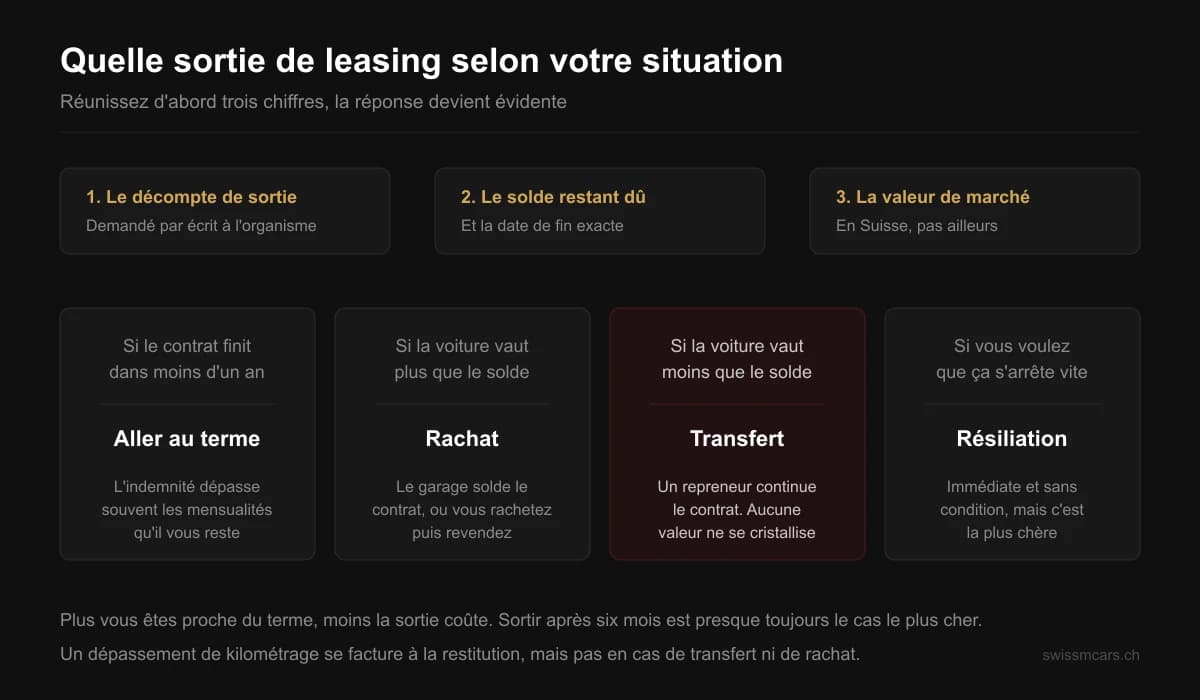
How to decide
- Contract ending in under a year? Compare first with going to term. It is often the cheapest.
- Car worth more than the balance? A garage buyout, or buying it yourself and reselling, gets you out without paying, sometimes at a gain.
- Car worth less than the balance? Transferring to a taker is almost always the least painful exit.
- You just want it to stop quickly? Direct termination. It costs, but it is immediate and unconditional.
If it is a taker you are after, or if you want us to look at your contract with you, everything happens on the lease takeover page: send us the terms and we will tell you honestly which exit costs you least, even when it is not ours.
And if you would rather change car for a lower monthly payment, the leasing calculator gives the figure for the cars currently for sale that can be financed, before any appointment.